Simple Front Yard Landscaping: What It Actually Costs and How to Get It Right
What simple front yard landscaping actually costs across Canada, how to define your scope before getting quotes, and how to compare bids so you don't overpay.
Your front yard is the first thing buyers see, the first thing neighbours judge, and the last thing most homeowners think to invest in. There's a reason for the disconnect. Backyards get the attention because that's where you spend time. But front yards are where property value lives. According to the National Association of Realtors, well-executed landscaping can increase a home's selling price by 5% to 15%. On a $500,000 Canadian home, that's $25,000 to $75,000 in perceived value from plants, sod, and a walkway.
The problem isn't motivation. It's scope. "Simple front yard landscaping" means different things to different people, and it means even more different things to three different contractors. One quotes new sod and edging. Another prices a full garden bed redesign with interlocking pavers. The third includes a drainage correction nobody asked about. You're left comparing three different projects at three different prices, learning nothing useful from the exercise.
Here's what each tier of front yard landscaping actually costs across Canadian markets, and how to define what you want before anyone picks up a shovel.
How Much Does Simple Front Yard Landscaping Actually Cost?
HomeStars reports that the average Canadian landscaping project runs $5,000 to $15,000 for residential work, with per-square-foot pricing ranging from $7 to $35 depending on scope and materials. For front yards specifically, the range compresses because you're working with a smaller footprint. Most Canadian front yards fall between 400 and 1,200 square feet, which means even modest per-square-foot costs can add up.
Those numbers shift dramatically depending on what "simple" means to you. Here's how the main tiers compare, based on HomeStars pricing data and published contractor rate guides across Canadian markets.
Fresh Sod and Clean Edges: $1,500 to $3,500

Stock photography for illustrative purposes
This is the reset button. You're removing whatever patchy, weedy lawn exists and replacing it with new sod, clean edges along the driveway and walkway, and a thin border of mulch against the foundation. No new plants, no hardscaping, no design fees.
Sod itself costs $0.75 to $2.00 per square foot for the material, according to The Grounds Guys. Professional installation brings the total to $1.80 to $3.50 per square foot in most Canadian markets. For a 600-square-foot front lawn, that's $1,080 to $2,100 installed. Add $200 to $500 for grading corrections if the existing soil slopes toward the house instead of away from it, and $150 to $300 for fresh mulch along the foundation bed.
This tier won't win any design awards, but it solves the most common problem: a front yard that looks neglected. If you're selling in the next 12 months or just want a clean starting point, this is where the math makes sense.
Foundation Plantings and Mulched Beds: $3,000 to $6,000

Stock photography for illustrative purposes
This is where curb appeal starts to mean something. You're keeping the new sod from the first tier and adding structured garden beds along the front of the house, a mix of perennial shrubs and groundcovers, and a properly mulched border that defines the space.
Garden bed installation runs $5,000 to $10,000 or more for a full backyard, according to HomeStars, but front yard beds are typically a fraction of that. A 100- to 200-square-foot bed along the front foundation with a mix of shrubs, perennials, and 3 inches of mulch costs $1,500 to $4,000 depending on plant selection and regional labour rates. Labour alone runs $50 to $150 per hour for landscaping crews across Canada.
The plant choices matter more than most homeowners realize. Native perennials and hardy shrubs cost less upfront and survive Canadian winters without replacement. Annuals look great on Instagram in July and cost you money again every May. A landscaper who recommends all annuals for a front bed isn't thinking about your maintenance budget.
Walkway, Beds, and a Street Tree: $6,000 to $12,000

Stock photography for illustrative purposes
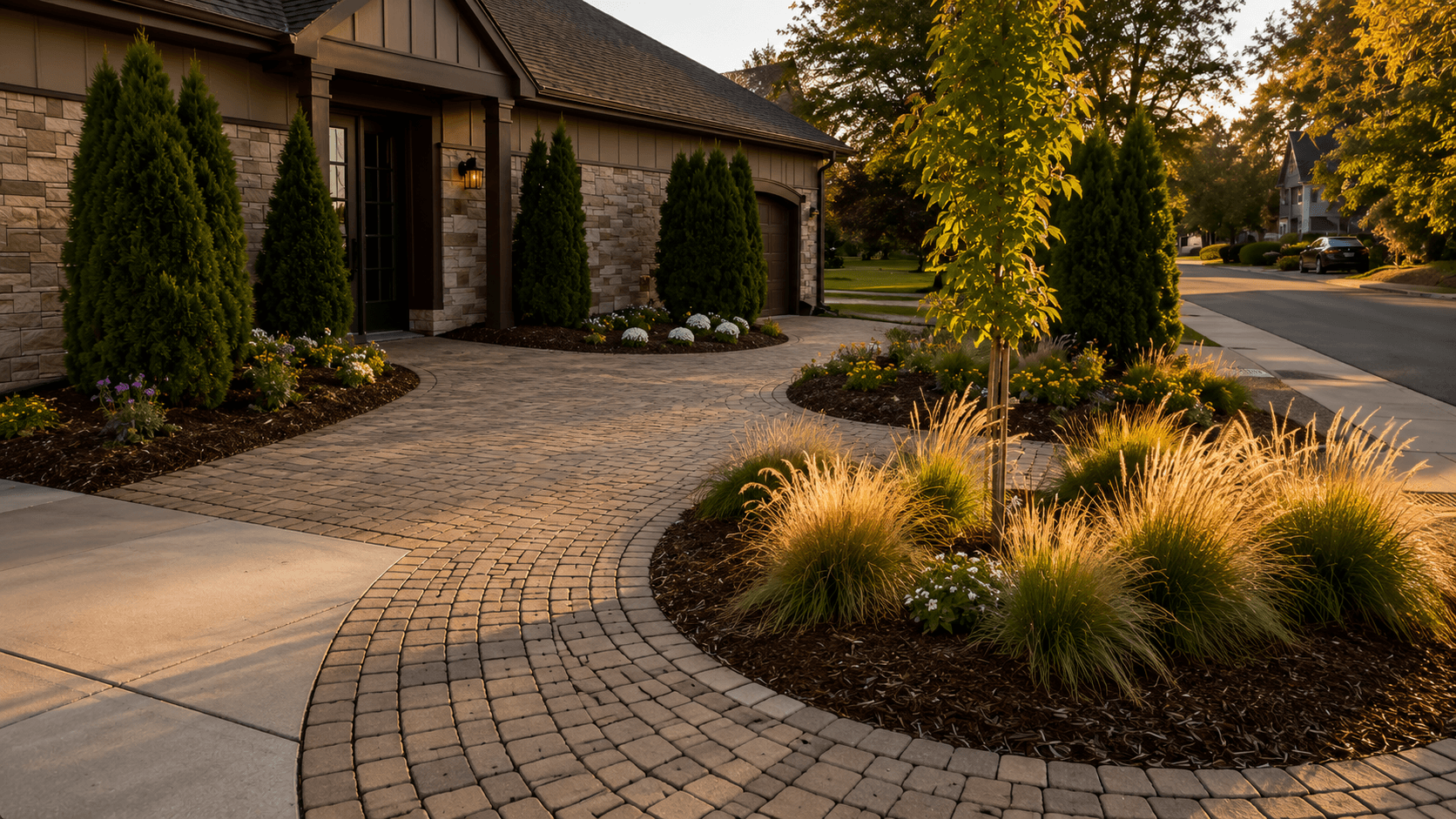
This is the tier where your front yard starts looking like someone designed it. You're combining sod, foundation plantings, and a proper walkway from the driveway or street to your front door. Add a specimen tree and you've created the kind of layered landscape that makes real estate agents take better listing photos.
The walkway is the big-ticket addition. Interlocking pavers run $18 to $22 per square foot installed in Ontario, according to pricing data from Landschaft Construction and Alterra Landscaping. A typical front walkway of 60 to 100 square feet costs $1,080 to $2,200 for interlock, or less if you opt for poured concrete ($5 to $12 per square foot) or natural flagstone ($15 to $30 per square foot depending on material). The HomeStars national average for pathway installation sits at $15 to $30 per square foot.
A single street tree adds $300 to $1,500 depending on species, size, and installation. That sounds like a lot for one tree, but the math works over time. A mature tree can increase property value by $1,000 to $10,000, according to Para Space Landscaping's analysis of Canadian property valuation data. It also reduces summer cooling costs by shading the front of the house.
At this tier, you're spending enough to justify getting two or three quotes and comparing them line by line. The difference between a $6,000 and a $12,000 version of this project is usually the walkway material, the number of plants, and whether the quote includes soil amendment, drainage grading, and removal of whatever existed before.
The Low-Maintenance Design: $10,000 to $18,000

Stock photography for illustrative purposes
This tier is for homeowners who want a front yard that looks intentional twelve months of the year without spending every weekend maintaining it. You're investing in a professional landscape design that specifies drought-tolerant plantings, hardscape elements that reduce lawn area, and low-voltage pathway lighting.
Professional landscape design fees run $2,000 to $5,000 for a front yard plan, though some contractors include design costs in the overall project price. The design fee pays for itself by preventing expensive mistakes: plants that don't survive your zone, walkways that pond water against the foundation, and beds that require weekly attention to look presentable.
Low-voltage landscape lighting adds $100 to $300 per fixture installed, according to Angi. A front yard typically needs 6 to 10 fixtures to light the walkway and accent key plantings, putting the lighting budget at $600 to $3,000 depending on fixture quality and whether you're running new wiring or tapping into existing circuits.
The real savings at this tier happen over years, not months. A well-designed low-maintenance front yard that uses native grasses, drought-tolerant perennials, and mulched beds instead of wall-to-wall sod can cut annual maintenance costs by half or more. You're trading a higher upfront investment for a yard that doesn't need weekly mowing, seasonal replanting, or constant watering through July and August.
These ranges cover the visible work: sod, plants, walkways, and lighting. They don't always cover the prep work that makes everything else last.
What's Not in That Price?
Site preparation is where the surprises live, just like it is with a concrete patio or a fence. The per-square-foot numbers in most quotes cover materials, plants, and installation labour. They often exclude everything that happens before the first shrub goes in the ground.
Cost Item | Typical Range | Why It Matters |
|---|---|---|
Soil testing and amendment | $200 to $800 | Clay-heavy or compacted soil won't support healthy plant growth without amendment |
Grading and drainage correction | $500 to $2,500 | Water must flow away from the foundation; improper grading kills plants and damages houses |
Existing lawn or bed removal | $300 to $1,200 | Ripping out old sod, removing stumps, or clearing overgrown beds |
Irrigation system | $2,000 to $5,000 | Automated watering for beds and lawn; not always necessary but often quoted separately |
Topsoil delivery | $200 to $600 | 4 to 6 inches of quality topsoil for new garden beds |
Municipal permits | $0 to $300 | Some municipalities require permits for tree removal, retaining walls, or grade changes near property lines |
When a contractor quotes $8 per square foot for garden bed installation, the first question is whether that includes soil amendment, topsoil, and removal of whatever is currently in the space. If it doesn't, you're not looking at the real price.
What Does "Simple" Mean in Contractor Terms?
It doesn't mean anything specific. That's the same problem you'd run into with a "simple" patio or a "simple" fence. The word saves nobody any money and creates confusion that costs you time.
A contractor who hears "simple front yard" might quote sod and edging. Another might quote sod, beds, and a walkway because they assume that's what you mean by "landscaping." A third might include a tree, lighting, and a full design plan because their average client spends $12,000 and they've calibrated their definition of "simple" to their typical project.
If what you want is new sod with mulched edges and three boxwood shrubs along the front of the house, say exactly that. "I want Kentucky bluegrass sod installed on roughly 600 square feet of front lawn, a 3-foot-wide mulched bed along the foundation with three Green Mountain boxwoods, and clean edging along the driveway." That sentence eliminates 90% of the ambiguity that inflates quotes and frustrates everyone involved.
Which Plants Actually Survive Canadian Winters?
This isn't a design article, so we won't tell you what to plant. But we'll tell you what to ask about.
Plant hardiness zones determine what survives your winter. Most of urban Alberta sits in Zone 3 or 4. Southern Ontario ranges from Zone 5 to 7. Vancouver's mild coastal climate is Zone 8. A plant rated for Zone 5 that gets installed in a Zone 3 front yard in Calgary won't survive its first February.
Every plant in your quote should have a hardiness zone rating that matches your location. If the landscaper can't tell you the zone rating of the shrubs they're proposing, that's useful information about the landscaper.
Native species are worth asking about specifically. They've evolved to handle local soil, rainfall, and temperature patterns. They typically need less watering, less fertilizer, and less replacement than imported ornamentals. Organizations like the Canadian Wildlife Federation and local conservation authorities publish native plant guides by province.
Perennials come back every year. Annuals don't. A front yard bed filled entirely with annuals will look stunning from June to September and cost you the same money again next spring. A bed designed around perennials with a few annuals for seasonal colour costs more initially but pays for itself by year two or three.
How to Write a Scope That Gets You Comparable Quotes
The single most useful thing you can do before contacting landscapers is write down exactly what you want. Not a Pinterest board. Not a photo from a magazine. A written scope.
Lawn area and sod type. Measure the space in square feet. Specify sod type if you have a preference: Kentucky bluegrass is the standard for most Canadian front lawns, but fine fescue tolerates shade better and needs less water.
Garden bed dimensions and plant types. Specify the approximate square footage of beds, the general type of plants you want (shrubs, perennials, groundcover, or a mix), and whether you want native species or are open to ornamentals.
Hardscaping. If you want a new walkway, specify the material (interlock pavers, poured concrete, or flagstone), the approximate length and width, and whether it replaces an existing walkway that needs demolition.
Existing conditions. Describe what's currently there. Is it grass, bare soil, overgrown shrubs, or an old garden bed? Note any slopes, drainage issues, or tree roots that will affect the work.
Lighting. If you want landscape lighting, specify how many fixtures you're thinking and where: walkway, bed accent, or both.
Maintenance expectations. Tell the contractor whether you want a low-maintenance design that handles itself or a high-impact design that you're willing to maintain weekly.
When three landscapers are quoting the same written scope, you can actually compare their numbers. Without it, you're comparing three different visions of what your front yard should look like, and the cheapest one might be the one that skips the topsoil.
What to Watch for in the Quotes
The same principles that apply to any home renovation quote apply here. Line items matter more than the total at the bottom. A quote that's $3,000 cheaper might exclude soil amendment, grading, and irrigation. That's not a savings: it's a list of things you'll need to pay for separately or skip at the cost of your plants' survival.
Ask about the warranty. Reputable landscapers offer a one-year plant replacement warranty on perennials and shrubs. Sod typically carries a 30- to 90-day establishment guarantee, assuming you follow watering instructions. If there's no warranty mentioned in the quote, ask why.
Check the payment schedule. A reasonable structure for a landscaping project is 10% to 25% deposit, with the balance split between a progress payment and final payment on completion. Any contractor asking for 50% or more upfront on a project under $15,000 warrants a closer look.
Ask when the work will happen. Landscaping in Canada has a compressed season. Most regions have a reliable planting window from mid-May to mid-October, with spring and early fall being ideal for sod and perennials. A contractor who promises to start your project in November in Calgary isn't doing you any favours.
The Bottom Line
Simple front yard landscaping is a $1,500 to $12,000 project for most Canadian homeowners, depending on whether you're resodding a lawn or redesigning the entire front of the house. The investment can return 5% to 15% in home value, and even a modest $3,500 curb appeal upgrade can yield meaningful returns when it comes time to sell.
The way to keep it from becoming a $20,000 surprise is the same as with any renovation: define the scope before you talk to anyone. Pin down the lawn area, the bed dimensions, the walkway material, the plant types, and the site prep. Send the same document to every landscaper you invite to quote. Compare what comes back line by line.
You're not looking for the cheapest front yard. You're looking for the one where you know exactly what you're paying for and exactly what you're getting.
Sources
Source | Data Referenced |
|---|---|
National landscaping cost ranges ($5,000 to $15,000 for residential projects, $7 to $35 per square foot), garden bed pricing, pathway installation costs ($15 to $30 per square foot) | |
Toronto-specific landscaping pricing, regional labour rates | |
Sod material cost ($0.75 to $2.00 per square foot), professional installation rates ($1.80 to $3.50 per square foot installed) across Canadian markets | |
Interlocking paver pricing ($18 to $22 per square foot installed in Ontario, 2026 data from Landschaft Construction and Alterra Landscaping interviews) | |
Landscaping impact on home selling price (5% to 15% increase for well-executed landscape design) | |
Landscape lighting installation costs ($100 to $300 per fixture installed, pathway fixture estimates) | |
Mature tree property value impact ($1,000 to $10,000 increase), curb appeal ROI data |
This article is for general educational purposes only and does not constitute professional landscaping, legal, or financial advice. buy better does not provide price quotes, cost benchmarks, or contractor recommendations. Costs referenced in this article are drawn from third-party sources and will vary based on your location, site conditions, soil type, and project specifications. Consult a qualified landscaper or horticulturist for advice specific to your property.
Ready to renovate the right way?
Get the 15-stage buy better® Home Renovation Roadmap.
Get the RoadmapAlready have a quote or contract?
Get a SafeSelect Contract Risk Review before you sign.
Review My ContractWant someone in your corner for the whole project?
Book a free Fit Call to see if DIWY is right for your project.
Book My Fit Call